Social Items

Showing posts with label Miscellaneous. Show all posts
The exams of all subjects are coming in December. Today, we got a chemistry class, and one of the questions in the test confuses me a lot. The question asks: Why do people add Chlorine in drinking water?

Add Chlorine to drinking water?
1
Is water with Chlorine drinkable?

My first uncertainty to this question is that: Is water with Chlorine drinkable? From my understanding of the element Chlorine, it is toxic. Chlorine in gas form was used as a chemical weapon during WWII, causing thousands of deaths. How could chlorine be added into drinking water?

I did some research online. There was an experiment in the 1980s about the effects of chlorine on human bodies. Both the animal experiments and human experiments performed directly with chlorine-treated water in this experiment showed high safety. No adverse effects were observed at a dose of 0.34 mg of chlorine per kg of body weight (This dose was the highest used in the experiment, so it was not clear that what dosage would be high).

As long as not too much Chlorine is added, it is safe for human body
But this doesn’t mean that Chlorine is safe for human body. After Chlorine enters a human body, a large amount of hypochlorous acid will be produced after a chemical reaction: Cl2 + H2O --> HCl + HClO), which causes the oxidation of tissues. Hydrochloric acid stimulates inflammatory swelling of the mucous membranes, making the mucous membranes of the respiratory tract swell and secretes a large amount of mucus, causing breathing difficulties. So therefore, the obvious symptom of chlorine poisoning is a severe cough. When the symptoms are severe, pulmonary edema can occur, making circulation difficult and possibly causing death.

Recently, I read an article from Singapore Eye: 罕见!新加坡5岁女孩游泳后全身红肿,刺痛无比……. The little girl in the article, after swimming, got a lot of bumps on her body of different shapes and sizes. They looked like mosquito bites, but they ranges from her upper body to the thigh, looking scary.

What caused such scary symptoms? Yes, it was Chlorine.
I still feel a bit scared after reading this. It was very lucky that the girl did not drink water from the pool. From the symptoms described in the article, her skin was stimulated by the Hydrochloric acid after the reaction of chlorine, but fortunate what swelled was her skin and not her throat, or else the consequences would be deadly.

2
Why do people add Chlorine in drinking water?
Simple answer: Sterilization

Bacteria is affected by hypochlorous acid in the same way (not sure if bacteria will be affected by hydrochloric acid, maybe through osmosis, but absolutely not because of a swelling throat). Since hypochlorous acid molecules are small in volume and do not have charges, it is very easy from them to go through the cell membranes. Hypochlorous acid is also a strong oxidant that can harm cell membranes, allowing protein and nuclei to fall out from bacteria (sounds disgusting), causing its death.

All in all, the amount of chlorine added to the water must not be too much, otherwise, let alone drinking the water, even pool water will cause great harm to people. However, as long as not too much Chlorine is added, human bodies will not be harmed.

Chemistry test - correct answer - sterilization.

Why do people add Chlorine in drinking water?

I was revising for Chemistry as we have a test tmr.

I started with a practice test paper and got stuck on a question about balancing the equation. The reactants are almost the same as the products, except there is one less hydrogen atom than the right-hand side.

I thought about it for about an hour, and I gave up. I searched it up on the web, and finally found out the difference of a few letters: It was Ammonium, NH4 on the left-hand side, and Ammonia, NH3 on the right-hand side. It's 10 already and I was really freaking out.

The Worst Mistake of the Month

Economics is a very new subject to me. I had use this word in many essays, in English and Humanities, but never went into the subject. Now that I get into Grade 9, I start this mysterious subject. Our first task was to give examples of economics in daily life, for example, when we are choosing the GCSE subjects.

We were to analyse the things that we should think about before deciding on choosing a subject. Although mine isn't very into the detailed things, but from the size of the poster that we were required to make and the economic terms that we were supposed to include, I'm sure I am doing mine quite well :-)

Economics here we go!

Economics from the very beginning

Recently, my friend shared this smart little cartoon. I found it so creative so I shared it here.

The cartoon is copyrighted under "我是白". Do not copy unless gaining permission from the original illustrator, which can be contacted through wechat official account or Weibo.

This cartoon could be just out of the illustrator's creativity, without any meaning, but these are what I gain from it:

1. Always be aware of those special things hidden around you. They could be surprises, could be beauty, could be inspirations. Do not miss these details, these essences of life and live with passion.

2. It is ok to different with others. It is not because that you are odd, it could be that you are the creative one. Live the style you like and do not stop because of other people's opinions on you.

The Chair

Recently, I read a report on a research project investigating the relationship between playing violent video games and aggressiveness. The report had lots of strength, but it also has a few drawbacks. (As I am just a beginner at Social Sciences, I am not going to talk about the technical things)

Link of the original report published on scirp.org: http://www.scirp.org/journal/PaperInformation.aspx?PaperID=49551&utm_campaign=NEWSPAPER2&utm_source=e_cp&utm_medium=psych_20140912_chengyuanyuan 

Download as PDF (Size:3423KB)

Manipulation

In the experiment, there was an important independent variable, which is to play violent video games or to play non-violent video games. The manipulation of the independent variable was done quite well. The experimenter has assigned an experimental group that was asked to play 16 hours of violent video games in the experiment, and a control group that was required to play 16 hours of non-violent video games. This is a good experimental design, as the students that went to the experimental and control group had similar characteristics at the beginning. By assigning two groups and exposing them in different conditions, it will be easy to find out the impact of violent video games on these students. However, based on the design of the experiment, there were still two drawbacks. Firstly, it might not be enough to just have two groups. The questionnaire and the EEG test the participants took before they started playing the video games might cause them to be expecting the result of the research study. Thus, they might be more aware of themselves being more aggressive and the group playing non-violent video games might be more aggressive than expected. Therefore, it might be better to have two more groups that do not take questionnaires (only EEG tests) before playing video games, one playing violent video games and the other playing non-violent video games. In this way, the impacts of video games on university students measured would be more accurate.

Secondly, as indicated in the report, male participants were more affected after playing the video games, which is partly because the main characters in the games are all male and it might be easier for male participants to identify themselves with the character. The experiment could be improved by having four gender-mixed groups: a group that plays a violent game with a male main character, a group that plays a violent game with a female main character, a group that plays a non-violent game with a male main character and a group that plays a non-violent game with a female character. In this way, it will be easier to see the effects of violent video games on both genders.

Measuring Instrument

Two measuring instruments are used in the research study, the questionnaire and the EEG. The questionnaire, in my opinion, is not quite reliable. One reason for it is that a questionnaire depends on how the participants felt about themselves, which is not accurate as being aggressive isn’t a good thing. The answers of the participants would be rather neutral and there would be fewer answers at the two ends of the scale, including “Strongly agree” and “Strongly disagree”.

The other measuring instrument used in the research study, EEG, was a very accurate type of measurement. (Although I don’t know how it exactly works,) By using EEG, the research study not only depends on how the participants felt about themselves, which the questionnaire does, but also has science-based shreds of evidence. This provides stronger and more reasonable support for the hypothesis that playing violent video games increases aggressiveness.

External Validity and Sampling Method

The external validity is very low in this research study. Firstly, the sampling method used in this research study is convenience sampling. All the participants in the research study are university students from local universities in Japan. This causes a great issue, as mentioned in the report: The results of the experiment can only be used to explain the effects of playing violent video games on university students in Japan at about the year 2014. This does not conform to the final result of the research study, playing violent video games causes aggressiveness, as the final result of the research study is universalistic.

Secondly, the procedure of the experiment could cause a severe threat. Although the experimental and control groups are randomly selected, the participants were still able to see that there were two groups. This formed a setting threat due to artificiality. The participants were likely to guess what the independent variable is (to play or not play violent video games) as the effects of playing violent video games were gradually becoming a more serious concern, and react to the fact that there was another group in the research study by having their own expectations of the results.

Thirdly, there are considerable differences between the participants. For instance, there were more male participants than female participants. This could lead to the possibility that the female participants are less representative than male participants. Another great difference was their ages. The age of the participants ranged from 18 to 29. 11 years of age difference could cause this group of participants to have lots of differences both physically and mentally. These are all variables that were supposed to be fixed in the experiment and not fully considered, causing the result being less accurate in descri

Analysis: Relationship between Video Game Violence and Long-Term Neuropsychological Outcomes

Hey everyone. I was previously in a reading group with lots of Chinese students in Grade 10 and Grade 11. The reading group prompts you to read a certain amount of pages every day and a book every month. I found it exciting and helpful. However, recently I found the book that we are supposed to read in the reading group is rather hard for my level. Therefore I was thinking of quitting the group instead of continuingly difficultly.

I am not saying that the books are bad. They are great books indeed, including Heart of Darkness and Catch-22. It is just that they are books that require higher maturity that I had not reached yet :-p I will just continue on the books that my classmates are reading.

Leaving the Reading Group

Recently, I read this article written by a Chinese student at Columbia University at New York, named "Why do Chinese Students Only Mingle with Themselves?" (https://socialwork.columbia.edu/news/why-do-chinese-students-only-mingle-with-themselves/) It actually describes my situation so accurately when I first went to UWCSEA in Singapore. Although now everything gets nicer, sometimes I still find myself in some of the situations described in the article.
In order to fit in, I take pleasure in learning American street lingo, such as “Pain in the ass!”; “You can’t have a cake and eat it too;” and “You’re a schmuck!” But still, I often feel like an outsider. I’m the only international student in my church. There are people who are welcoming when I first meet them, but once they realize that they can’t have natural conversations with me, they only say, “hi” and then move on to talk to someone else. I try to initiate conversations with others, but oftentimes even when they respond to me, I don’t know how to make the conversation flow. I wish I could be witty, but I don’t know how to do that in English. In Chinese, I enjoy making jokes and puns, which makes my personality more colorful.
--Annabelle Liu
When I read this I was totally shocked. "Oh my god" how could this be exactly the same as what I encountered at school! I remember the first year I came to UWC, we have Music class in those kind of buildings underground, with long corridors and classrooms on the two sides. Before the lessons, we usually just sat on the ground in the corridor and waited for the music teacher to get prepared. This was when people with "one best friends" sat with each other and chat, speaking with an American accent and in a super-fast speed that I will never catch a word. I always sat down by the instruments, besides a french horn. It was like this the whole semester, that I even started to get used to the french horn. I knew it shouldn't be like this, being so quiet that I didn't even quite recognize myself, while lots of my other classmates in my primary school in china were admiring my life, the opportunities that I have got, while I have promised the admission officer when I went for the school interview, that I was really popular in my last school and that I have bunches of ways to make friends.

After I was first transferred to UWC, the unfamiliar feeling of being surrounded with foreigners faded within two week's time. I have decided to get closer to someone. It will be easy, I thought. I have went on cultural-exchange trips, which I went to a local school in Britain and made friends with lots a few students. It wasn't hard. Walk towards people, introduce yourself, talk about how you came here, talk about holiday plans, keep talking. Although I sometimes got stuck on explaining something, people will always wait patiently.

I swallowed as I walk towards someone who looked nice. I said "hi", she said "hi", I said that I was from China, she paused for a second, smiled and commented: "Cool!" So I continued, telling her that I am going to New Zealand during the summer holiday. I expected her to introduce where she will be going. It didn't come out well, I made a lot of grammar mistakes and got stuck for several times. When I finally finished, I looked at her nervously, not sure if she understood it. She just commented briefly again: "Nice!" It was really awkward, and it was the first time that I realized I couldn't really chat normally with them.
There are times I try very hard to make a conversation with someone by asking questions or talking a lot by myself, but for some reason, they respond minimally and seem to want to move on to the next person. Once they find someone else to talk to, their facial expressions suddenly turn joyful and they become talkative, as if they are transformed into a completely different person when they are not talking to me.
--Annabelle Liu
This has been the situation for a very long time, too. I have this really good friend, let's call her Ella. Ella was a nice person. She was Chinese, but her whole family moved to the states when she was two. She came to Singapore when she was in grade two. She was in my Chinese class, and as I am pretty good at Chinese, I always helped her on class. She was very nice and has a bunch of nice friends that I could not really communicate with (We were good friends now). As I wasn't very good at English, we normally communicate in Chinese. When I spoke Chinese, she just walk by my side and said nothing. I knew she could understand, she just couldn't speak Chinese fluently. It was the same when she was speaking English. I usually smiled and listen. It was pretty awkward in this way so that Ella always left her friends to spend time with me individually. I felt quite sorry. Every time I saw Ella leaving her friends I thought. It was me that separate Ella with her friends. It seems to be easy making a friend, but when you really start to do it you will realize in awe that it is the hardest thing that you've ever tried to do.

Since these experiences, I started to walk towards the Chinese intentionally. The "Chinese Pile" was the safest place for me. If I try to merge into foreign students, I might end up staying silent due to awkwardness, saying not even a word the whole day, whereas if I stay with the Chinese group in a reasonable way, I might begin to be more confident and comfortable by starting to practice English with them, preparing to make more friends in the future. So if people were curious of why Chinese students only mingle with themselves, I would answer: "I am just trying my best to be more social." If you also have the same kind of problem, please feel free to make friends with people from your own country. You are doing nothing wrong to make friends of your own choice.

"Why do Chinese Students Only Mingle with Themselves?"

Plastic is a common material in our daily life. Furniture, cutlery, stationaries, everything is made out of plastic. Plastic became popular in the 20th century, not even 100 years ago. In 1955, “Throwaway Living” was promoted on “Life” Magazine, for its great convenience – people did not have to spend hours of time on cleaning things anymore, everything was single use and disposable. However, this “throwaway living” affects the Carbon cycle to a great extent in the process of production, transportation, and incineration of plastic.

From recent reports, the production of 1 kg of polyethylene (PET or LDPE), the most commonly used plastic, requires the equivalent of 2 kg of oil for energy and raw material. Transportation of Plastic is also a large part of plastics Carbon footprint. Plastic bottles are made of resins derived from oil or refined petroleum and natural gas. The petroleum and gas are sometimes transported long distances to plastic manufacturers, using fossil fuels and producing emissions of greenhouse gases. The transportation energy expenditures can represent as much as 29 percent of a plastic bottle's carbon footprint. Moreover, none of the commonly used plastics are biodegradable so in order to eliminate these plastics, destructive thermal treatment have to be used. The incineration of plastic needs around 4 kg of oil and thus also emit lots of Carbon Dioxide. Normally, before the 19th century, the Global Atmospheric Carbon Dioxide never exceeded 300 ppm. In 2018, Global atmospheric Carbon Dioxide was 405.0 ppm and in the total emission of Carbon Dioxide, 10% were caused by the Plastic Industry. This affects the Carbon cycle to a great extent. But first, what is the Carbon cycle?

The Carbon Cycle is the process in which Carbon atoms rotate in different parts of the Earth. For example, the process begins with plants, which absorb Carbon atoms from the air during photosynthesis. The Carbon atoms then move from the plants to animals when plants are consumed. After the plants and animals died, the wood, leaves, and body will decay, transferring the Carbon underground.

Normally, Carbon underground gradually goes into the ocean, from the ocean it will go into the atmosphere and the ocean will absorb carbon from the atmosphere. This balances the Carbon Cycle. However, human beings were taking more Carbon from the underground, for example, getting hydrocarbons like oil to produce plastic. Humans were also emitting more carbon into the atmosphere, through the incineration of hydrocarbon products like plastic bottles. Therefore, the carbon concentration in the atmosphere increases. These acts did not cause or destroy the Carbon Cycle. It simply makes some processes of the cycle faster and resulting in some consequences due to the imbalanced Carbon Cycle.

There were two main consequences of a high atmospheric concentration of Carbon Dioxide. Global Warming was one of them. As more Carbon Dioxide was building up in the atmosphere, making it thicker, greenhouse gases trap heat radiating from Earth to space. This heat, in the form of infrared radiation, gets absorbed and emitted by these gases in the planet's atmosphere, warming the lower atmosphere and the surface. This resulted in climate change, that has even more consequences: more frequent wildfires, longer periods of drought in some regions and an increase in the number, duration, and intensity of tropical storms. These natural disasters brought great inconvenience, danger, and harm to our planet.

The other consequence is the increase of acidity in oceans. Because of the high concentration of Carbon Dioxide in the atmosphere, the ocean takes in more carbon from the atmosphere than it releases. As a result, the carbon dioxide gas will react with water molecules to release hydrogen, making the ocean more acidic. Since the beginning of the Industrial Revolution, the pH of surface ocean waters has fallen by 0.1 pH units. Since the pH scale, like the Richter scale, is logarithmic, this change represents approximately a 30 percent increase in acidity. As a consequence, many marines animals were threatened. Humans and many other animals that consume marine animals in the food chain will also lose an important food source.

There are so many consequences of the Plastic Industry, is there an alternative? In my opinion, plastic is very common, and our lives are inseparable from it. Its convenience brought to us makes disposable bags irreplaceable by any other types of bags. There isn't a problem with a disposable bag, it's just that there must not be any Carbon in the disposable bag. Avani (https://www.avanieco.com), a company in the Philippines reports that they have created a truly environmentally friendly solution to the plastic pollution problem. With a mixture of cassava root and vegetable oil, Avani produced a bag that seems to be legitimately biodegradable, dissolving rapidly in hot water and safe for animals to ingest. In fact, Avani says that animals seem to love the taste of the “Eco bag”. It will be easy for people to change from plastic disposable bag to Avani disposable bags.

How the Plastic Industry Affects the Carbon Cycle

Notes: I copied journals of the first three days to Dubai from my mum's blog, but this post is originally composed by myself.

------

In the morning, we went to Palm Jumeirah, an artificial island sticking out from the mainland. The creation of it started in 2001 and finishes in 2011. To have a better view of the whole island, I used google maps and zoom out, finding out that the whole island was in the shape of a palm tree, connecting the mainland on its trunk. There are also two other artificial island. One of them was consisted of lots of small island, forming the shape of all the continents in the world. The other was in the shape a bigger palm tree (I still think the small palm island was more delicate. It probably costed a lot of money and natural resources to build all these things in Dubai: The tallest building, artificial island, etc., but it was actually very effective in attracting tourists from all around the world).

Interactive map▼


Atlantis was not an unfamiliar name to me. Months ago, Allie and me watched a movie called Aquaman together. Atlantis, in the movie, was the name of the sea kingdom. It was once a glorious kingdom on an island, everything was made out of gold, silver or ivory. However, Atlantis was not the only civilization at the time. Lemuria,  another hypothetical civilization, bombed Atlantis. The whole island sank, people in the kingdom evolve and were able to live in the ocean.

After researching, I found that the background information of Atlantis in the movie was actually based on a hypothesis of the Greek philosopher Platon. The hypothesis was famous over the theorists and authors. The elements of the hypothesis was found in different cultures of different time periods.

I thought that the movie"Atlantis" and the Dubai "Atlantis Luxury Hotel" were two separated things, and it was just a coincident that they have the same name. However, as we walked into the aquarium next to the hotel building, we saw this:


Which reminded me of this:


They were actually the same thing! But as I know, Atlantis aquarium was opened for years already. Perhaps Aquaman was inspired by this sculpture and invited the actor to cast Aquaman for them?

I was really not sure, but we still took some photos:


While dad was buying tickets, Ariel was attracted by a video on the counter, with some tourists playing with sea animals such as seals, penguins and killer whales. I took a look at it and found that it was actually a virtual reality video. The animals were all added into the video later and all the tourists had to do was to act, as if there are actually animals there.

Acting time!

Killer whale!


The polar bear:
Ariel reacted so fast and kicked it on its head!


Playing with the dolphins!


And a close contact with a seal! (Now everyone expertized at acting)


Comparing to the aquarium in China or in Singapore, this one was so much more delicate. It was not that it had more fish in the display area, but that it was more well-designed. For example, the whole aquarium has a theme of the movie Aquaman (again, I have no idea why these two are related, but there were lots of  special designs in the fish tanks such as the helmets wore by the main characters when they were in a competition, the costumes of them and the weapons they used for fighting).

See that helmet with two sharp thing sticking out? That was the costumes of the bad guys Aquaman's brother hired to catch Aquaman (Ariel cried cuz she lost when playing a game with me)


The point was not the sea eels (still they are very lovely, there was a really thick one that couldn't get into the holes). It was the holes they rested in. I remembered that this is also an element from Aquaman, in the great castle where Aquaman and his brother first met.


Ariel saw a fish that looked exactly like Gill in Finding Nemo. She kept on yelling "Gill comes! Gill comes!" in Chinese and everyone laughed.

We had travelled around the whole aquarium. Ariel went to the souvenir shop. Arial chose a turtle (we went back to hotel and found that the hotel had a gift for us, which is also a turtle of the same size).

We got out of the aquarium and headed straight to find a restaurant. Finally we went to an Italian one. I had lasagna and Ariel, as always, had pasta. However, my lasagna somehow was really salty and no one could eat it, so we order another Spaghetti Bolognese and share.


Afternoon. #full #sleepy #cannotmove

We got on a car, going to DESERT SAFARI!!!

Desert Safari was a famous activity, popular over both the tourists and the locals. It was to drive a special off-road vehicle and travel on the sand dunes in the desert, going up and down the dunes as if riding a roller coaster.

The car we sat in the image above was not a simple car, too. The driver told us that it was designed for desert safari and even if we lost control, turned upside down or bumped onto a dune, we would be save.
(Then I asked if this could prevent car crashes on the roads, the driver said: "... Hmm. Only on sand...")


There were almost no cars on the road so we always got to slow down to observe things. For example, when I saw a building with letters on the top that says: The Camel Hospital, I was actually shocked, imagining a hospital with camels as doctors. Then I realized that things weren't what I imagined...

On the way we saw some camels in training. The camel trainers were riding adult camels on the left side, and there were the young new camels, only two years old in average, on the right side. They looked almost the same as the adults, except that they were shorter, had smaller heads, and that they do not have the cuts and calluses on their legs.

We finally got to a station. Lots of other people who went here for Desert Safari also stopped here. Every one had to wait, until we were told to go (perhaps when the last group of people who went left). While we were waiting, Ariel and me bought two scarfs. The person selling it could speak Chinese (probably an autodidact, meeting so many Chinese tourists everyday)!

Onto the sand dunes:
The driver stepped on the accelerator and the whole car rushed forward. The sand we travelled in in the beginning was quite flat. The driver turned left and right to help us getting used to the temperature in the car and being prepared for the dunes.

We went in front of a dune. Comparing to the dunes we saw at the station, now they seemed to be so huge, so tall that we could not see what was on the other side. Accelerator. Vroom. The whole car was tilted, with the front part of the car pointed directly at the sky. Then I screamed. Loud scream. I did not know how and when the car would got to the top of the dune and turned head down. The unknown dragged me into the abyss of fear. A stop. A stop that was so long that I got to realize that this was the calm before the storm. Damn it, go please!!! It went. Head down, diving down from the dune that created an almost-80-degree angle. Phew. We finally went pass the dune! Oh no, there was another...

We went pass hundreds of dunes, and was a little bit used to it. I stopped screaming, and dad and mum stopped thinking (and screaming) that the car would turn over. But then every one got a bit carsick. We found a pause point and get off the car.

We finally got to a stop point in the middle of the dessert and started walking in the sand. Ariel and me started playing in the sand. The sand here was very different from the sand on the beach. It was much softer, much smoother and finer. This means that after we sat on the sand and got up, there would be lots of tiny sand particles stuck on our trousers and not getting off even after the trousers were washed...

Sand here was also hotter. I took off my flip flops and tried to submerge myself in sand. I regretted the second I did so. The sand was burning. It seemed that it could not only cook an egg, but also an omelet. I tried to put my flip flops back on, but the harder I tried, the deeper it went into the sand. This was the worst moment of the day.

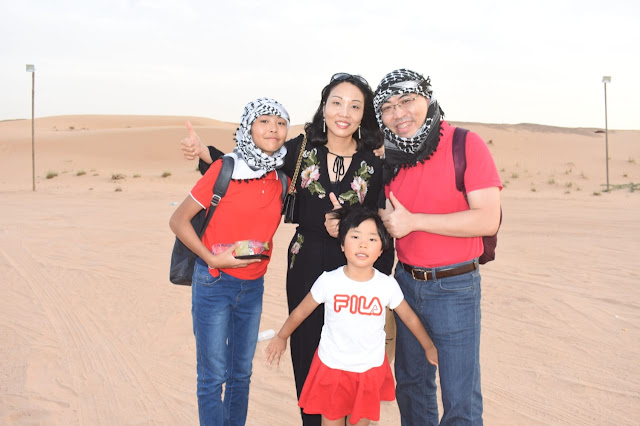
Photo time! The red clothing we wore really stood out from the sand and did not absorb heat.

Family Photos:-)


I decided to use this image as my profile photo:

Heading to a camp in the middle of the desert

Ariel was suddenly got mad cuz her sandals were full of sand. But it's fine. We would reach the camp in a few minutes.
The camp took a photo for us with a camera, but it looked a bit like those kind of faded old photos.

There were lots of people in the camp already. The "camp" seemed to be kind of simple and crude -- there was only a few tables and chairs. However, this was actually a kind of luxury in a desert -- all the floors were covered with bricks, grass was planted and there were also a few trees!

Dad went to take some drinks, and then a guy in white robes came. He was holding a falcon, the national bird of Dubai, and called people to take photos with it.

This was the first time that we saw a falcon, so all of us took photos with it.


(It was too hot and I wasn't feeling very well)


Back to the hotel finally! Ariel started her Chinese time and I started on my SAT vocabs. This was such a full day!

Our Trip to Dubai -- The 4th Day -- The Atlantis Aquarium and a desert safari


Hi UWC students, teachers, and parents,

As you may know, we, a group of Grade 8 students (Leon Hunte, Hugo Hannigan, Jessica Morgan, and David Walton), are organising a school strike this Friday (24th). We are protesting against climate change, inspired by Swedish activist Greta Thunberg and the Fridays For Future movement that followed. More than 1800 strikes are being held worldwide on every continent this Friday, in an organised Global Strike, and in many places strikes are held every week.

Here, in Singapore, the laws around protesting and striking are relatively strict, and therefore the UWC strike will be kept private, meaning that we will not be inviting people from outside of the community to join the strike, nor will we leave school property.

We recognise and applaud the fact that we go to a fantastic school that works hard to reduce its impact on the environment and that all students, at the very least, know what Climate Change is and some of its effects. However, our ideal objective for the strike is to make everyone in the UWC community as informed and engaged in the climate action movement as we are, as well as to encourage the school to work even harder to be even more environmentally sustainable. This could mean increasing existing climate initiatives such as Veggie Wednesdays and No Drive days or doing other activities such as beach clean-up.

Important strike details:
This Friday, the 24th of May from 08:30 to 10:00. Participants will walk out of class, respectfully explaining where and why they’re striking to the teacher if their teacher asks.
The participants will meet in the Tent Plaza, where they will meet and strike until 10 o’clock, before returning back to Advisory Group.

We will use our voice. We will stand for what is right, and make a real difference. Despite our age, we have power, and we will use it together with the thousands of others doing it with us to fight against climate change and to save the planet for ourselves and all future generations.

Join us.


Links:

Email us: hunte72864@gapps.uwcsea.edu.sg or hanni80103@gapps.uwcsea.edu.sg or walto71383@gapps.uwcsea.edu.sg

Our Instagram account, ‘fridaysforfuture_uwc’:
https://www.instagram.com/fridaysforfuture_uwc/

The Fridays For Future Instagram account.
https://www.instagram.com/fridaysforfuture/

Fridays For Future website, including a map of climate strikes worldwide.
https://www.fridaysforfuture.org/

Instagram account of Greta Thunberg, who started the school strike movement
https://www.instagram.com/gretathunberg/

A useful strike guide for students, parents, and teachers made by Fridays For Future
https://docs.google.com/document/d/1vzhamVa5k1dYnUAvcxO6hF9MbtxHGVtnY2he5rkOSA4/edit#heading=h.u4441kl4mncv

School Strike for Climate Change


9 Brooklands Drive
Ashton
Wigan
Lancashire
WN4 7RJ
17th November 2018

The Wigan Observer
Wigan
Lancashire
WN1 8XY

Dear Editor,

I am writing to express my total disagreement for your point in the article: Tattoos prove that the human race is going backwards. It does not make any sense at all.

Tattoos are a form of art in lots of cultures that exist even before Jesus Christ. It was precious, invented with the intelligence of our ancestor and was first made with simple tools such as fish bones, bones and oyster shells, and was usually used to convey medical information of the wearer. Although modern people who wear tattoos were, obviously, out of different purposes, tattoos were still a valued cultural heritage that needs our help to pass it on. It is wrong to say that tattoos are causes or results for the human race going backwards.

Tattoos are also a way for people to express themselves. Yes. Those with tattoos have other ways to express themselves, for example, by writing, speak to others, posting it on social media, or let other people do these to them. However, every human being has the right to choose their way to do it. Some people might find tattooing a more artistic way than simply writing down words, some people might found tattooing empowering and encouraging, and some people might want others to look at him in the way he wants them to with the tattoos. These were all reasonable, and it is arbitrary to criticize others without knowing them.

I resent those people who see tattoos as signs of violence. Tattoos should be socially acceptable. It is a fact that the majority of male criminals have tattoos. One explanation of this is that they always tried to seek ways to express themselves. On the other hand, criminals were not the only ones who have tattoos. Other people with different jobs, including athletes, artists, poets, designers. Tattoos may have a different meaning to them. Many celebrities have tattoos: Winston Churchill, King George V, Franklin D. Roosevelt, George Orwell and Thomas Edison among them. Do people usually consider them as violent criminals?

Yours faithfully,

Cecelia Luo

Tattoos: human race is going backwards?


I found it a bit sad to leave Middle School. It was such a year of excitement and I improved a lot. In academics, I found out that the learning strategy that works the best on me was to practice. Practice makes perfect. In Math, I tried to do and did all the questions on Teamie, and now I am able to solve Math problems in a quicker speed. I used to find it hard to read in English, but this year I read more and was able to scan through texts. I participated in Tabitha, a Cambodia Global Concern this year. I contributed to Tabitha by help raising money. I introduced the GC to the families of my sister’s friends at school, and they really appreciated it. It was a large percentage of all the money I raised. A challenge in Tabitha was that you need to introduce the program every time you try to raise money. To do this, I need to read through the whole Tabitha website, which helps me myself to understand the program more. From the trip to Cambodia, I learned that helping people in poverty wasn’t just about raising money. The mental help we gave them was also very important. In the aspect of outdoor education, I enjoyed the Chiang Mai expedition trip a lot. During the expedition, I got to do many things that I have never done before and things that I would never do without the expedition. I got the opportunity to get out of my comfort zone and do things on my extreme. After I went back from the expedition I started to realize the preciousness of the environment I live in. It is not that I do not like outdoor activities, but I still find it quite challenging. I found out that there is more in me than I thought. In the expedition, when we were traveling from campsite to campsite, carrying the 40l backpack, I thought I would collapse on the way, and I would definitely give up if I had the chance. But in the expedition, I did not have the choice, so I kept walking for more than 3 km. This made me realize that it was hard to get out of my comfort zone, but doing so is not going to harm me. During my Advisory Group time, we usually read the news together. We shared our opinion about news articles. This helps me to know more about the world around me, and it also allows me to know about other people’s opinions towards the same thing. I contributed to my AG by sometimes sharing my opinion. I also learned about how much time a person could waste on doing two things at a time. I tried to do more time management, and it did help. I participated in the school Badminton team and took part in a few matches. I do badminton training twice a week and I am planning to go to the U19 badminton trial next year. The character strength that I demonstrated the most was forgiveness, I was calmer and objective when someone did something wrong. I have many goals for myself next year, but the most important one is to have good time management because there will be so much more things to do next year and time management was the basis of doing everything.

Grade 8 Reflection


I am very glad that I participated in this trip. Although it was my first time to Cambodia, my head was already filled with precious memories. There were lots of things that I haven’t seen or experienced before. Throughout the whole trip, there were two things that left a deep impression on me.

The First Thing

It is the history day. We were visiting S-21, an outdoor genocide museum. I was listening to the audio guide. I learned that Cambodia was a powerful Kingdom a long time ago. However, in the 1970s, it suffered a lot from the Khmer Rouge massacre. The national strength declined a lot and even after so many years, Cambodia is still one of the least developed countries in the world. A large number of families are still struggling due to poverty. The history made me feel sad and I sat down on a bench next to the chain link fence (surrounding the museum). Then I heard footsteps behind me. I turned and found a little girl, perhaps 8 or 9, glazing at me through the fence. “Perhaps she was going home to have lunch.” I thought, and waved at her with a smile, but then I saw that she was whispering something to me. I walked closer to her, and realized that she was saying the word “money” in English.

I was a bit surprised. The girl was just 9. She was supposed to be carefree and bright, perhaps playing with her friends or learning in a school, but right now perhaps due to poverty, she was not able to go to school and had to wait here at the fence, trying to get tourists to pity her. I hesitated for a long time, thinking if I should give her money. I was also thinking to walk away, but then when I looked into the girl’s pitiful eyes again, my heart was softened. I took out a pencil and gave it to the girl, hoping that she would take it out of the desire to learn which, I thought, every kids should have. The little girl saw the pencil, paused for a second, and then shook her head hard. She carefully pushed my hand away and whispered "money” again.

I did not really remember how I walked away from the girl with my heavy heart filled with disappointment and sadness. This was the first time I realized how serious the issue of poverty is.

The Second Thing

It is the first day of housebuilding, the third day of the trip. I was sitting inside a half-built house, hammering the nails to fix the bamboo sticks on the floor. There was also an old woman sitting next to us. She seems to be very experienced. I needed to hammer 40 times to knock 1 nail in, she could knock a nail in just by raising her huge hammer for three times. Some of the bamboo sticks were a bit bent, therefore every time you hit a nail, the stick will bounce and pop the nail out. Whenever I encounter this kind of difficulty, the old woman came to help with a warm smile on her face. Within 5 seconds, the nail that makes me desperate would be firmly nailed into floor. After she finished, the old woman would point to the nail and say "Ha", then smiled warmly at me. Although I did not understand her language, I could still feel her pride and joy after helping us foreigners. From this experience I found out that we could all make a change. Tabitha offers us an opportunity to interact with these villagers. We could show them that we truly wanted to help them saw them as equal. It also allows the villagers to show their skills, their joy with confidence in front of us. In contrast, when we just came to the village, all the villagers were very nervous and glazed at us suspiciously. They had been told by others that they were bad, and their lives were hard because they were bad. Housebuilding had really made them more confident, telling them that they were good. This change has impressed me a lot.

As a conclusion, the trip was very memorable to me. Cambodia did experience terrible things that results in its current situation as one of the most undeveloped country. However, I believe that with help from Tabitha and other organizations, gradually, Cambodia could rebuilt the brilliance of the Khmer Kingdom.

Tabitha Reflection (whole trip)

My name is Celia, and I noticed that you are quite interested in Singaporean arts. Here I would like to recommend a masterpiece from a Singaporean Artist, Andre Tan. Tan is a Singaporean Pop Artist. He is very creative. He often blurs the boundaries between reality and the unreality, mixing cartoon characters, brands, patterns and images of people together.


When you first look at this piece of art, you might be wondering, what is the style of the art and what are those characters around the artwork? Well, knowing a bit of background information helps a lot.

Singapore, a country in the South east Asia, is a country with lots of culture. The art has lots of elements of the different cultures. When Singapore was still part of Malaya, a colony of Britain, its population were mainly Chinese, so a large part of its culture is influenced by Chinese culture. Singapore, after its independence from the British in 1963, was admitted as a state of the Malayan Union. As a small country, it would be very hard for Singapore to live on its own without the Union. The prime minister Lee Kwan Yew encourages Singaporeans to learn Malay, so they could be better merged with the Union. As a result there were also influences of Malay culture in Singapore. Now back to the artwork. Did you noticed that it is only in two colors: blue and white? This is a popular pattern of porcelain in China. The Chinese white and blue porcelain already existed in the 9th century. Also, usually there are blue decorations on the edge of the plates and the pots. Despite the patterns, there are two circles on the left and right side of the artwork, with two Chinese characters inside. So, the circle shaped flower patterns background and the characters in Tan’s artwork were all influences of Chinese culture.
You can also see a word on the top of the painting on a banner is in Malay. This is an influence of the Malayan culture.

As you can see, there is a 1965 banner at the bottom of the art work. The word “Merdeka” on the top of the art is from Indonesian and Malay language, meaning independent. From these we could guess that the history background of the artwork is the independence of Singapore from the Malay Union in 1965. The two Chinese characters in the circle, 国父, means the father of the nation, indicating that that the person in the center is the father of Singapore – Lee Kwan Yew. LKY is the first prime minister of Singapore, ruling Singapore for 3 decades. In 1965, the malasian parliament passed the required resolution that would sever Singapore’s tie to Malaysia as a state, and Singapore knew nothing about it before. Singapore's lack of natural resources, a water supply that was derived from Malaysia and a very limited defensive capability were the major challenges which Lee faced. However, with Lee’s great leadership, Singapore was described as transitioning from the "third world to first world in a single generation". Lee was then recognised as the nation's founding father.

This artwork is very significant. It is not only because that it has the elements from different cultures, but also because that it represents a significant historical event. Moreover, think about the challenges Lee faced when he was determined to lead Singapore out of the difficult situation. It requires lots of courage. An artwork like this always motivates people, giving them the courage to do things when they are frustrated.

The artist probably created the art to commemorate Lee. The beautiful patterns around Lee always remind people that once, Lee was a great leader and has built Singapore into a prosperous country out of nothing. The artwork was created via digital tools. It has appropriated an image of Lee in his early 30s, changing it into a different style that fits his work. Except this, Tan, the artist, created the concept, the composition of elements on his own.

I think the piece is very good and it really does impress me a lot. It let me to respect the courage of the prime minister, his great leadership that had changed Singapore from a little state into a multicultural developed country. The contrast before the independence and after that is like a blank canvass and this piece of art. Every time I look at this it leaves a deep impression in me.

"国父" by Andre Tan